Taiwan
Taiwan Patent Registration (TW Patent): Types, Fees & Process
A patent is a legal right granted to an inventor that gives exclusive control over an invention for a limited period, preventing others from making, using, or selling it without permission. In Taiwan, securing a patent is an important step in protecting intellectual property and supporting commercial innovation.
Taiwan offers 3 different types of patents, all governed by the Patent Act, which sets out the rules for patentability, application procedures, examination, and enforcement. The system is administered by the Taiwan Intellectual Property Office (TIPO), which is responsible for examining and granting patent rights. The Act is designed to promote innovation and align Taiwan’s patent framework with international standards.
In this article, we will provide you a brief overview of the patent application process in Taiwan and the key points to know.
3 Types of Patent in Taiwan
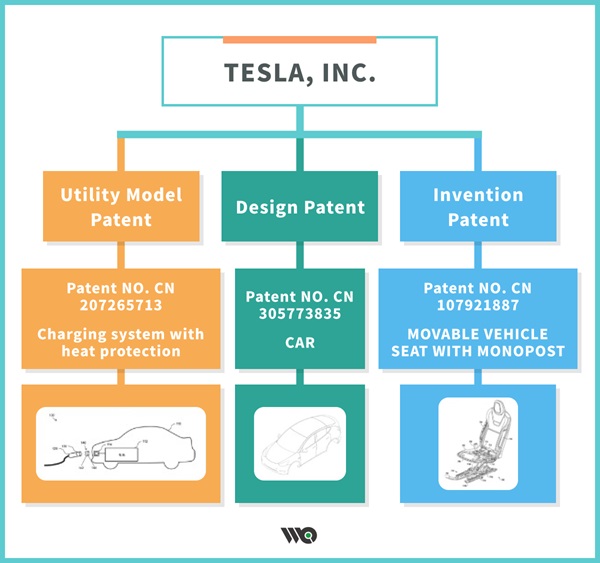
Patents in Taiwan fall into three categories: invention patents, utility model patents, and design patents. However, not all creations are eligible for patent protection. Invention patents, for example, do not cover animals, plants, natural biological processes (except those involving microorganisms), or medical procedures like surgeries and treatments. Anything that goes against public order or morality is also excluded from protection.
Utility models and design patents also have restrictions. Utility model patents can’t cover purely functional designs, and design patents cannot protect fine art, circuit layouts, or objects that violate public ethics. Understanding these exclusions is key before applying for a patent in Taiwan, as it ensures your application meets the necessary criteria.
Invention Patent
An invention patent pertains to creations that harness inherent natural laws to solve problems and achieve specific objectives or purposes. These inventions must possess technical characteristics, indicating that the means employed to address the issue involve technical elements within the relevant field. Discoveries, scientific theories, the presentation of information, and aesthetic creations are ineligible for this patent protection.
Patent Fees: Higher*
Patent Term: 20 Years
Processing Time: 12to 24 months
Note: The official fees are at least NT$10,500 (for the specification, claims, abstract, and drawings totaling less than 50 pages and with up to 10 claims).
- For each claim exceeding 10, an additional NT$800 is charged.
- For every 50 pages exceeding the initial 50 pages of the specification, claims, abstract, and drawings, an additional NT$500 is charged.
Utility Model Patent
A utility model patent refers to a creation based on the laws of nature, creates a tangible entity, and demonstrates innovation in the shape, structure, or combination of the entity. These entities must have utility value, physical substance, and practical use. Obtaining a utility model patent is relatively less expensive and involves less strict registration requirements compared to regular patents as it is subject to the formality examination.
Patent Fees: NT$3000
Patent Term: 10 Years
Processing Time: 4 to 5 months
The scope of protection differs between invention and utility model patents. Inventions cover a broader range, including substances, objects, methods, biological materials, and their uses, while utility models only cover the creation of shapes, structures, or combinations of objects.
Design Patent
A design patent refers to a creation that presents a visual appeal through the shape, pattern, color, or combination thereof of an item. It also includes computer-generated graphics or icons and graphical user interfaces (GUI) applicable to items. These creations are presented via display devices and evoke a specific visual appeal.
Patent Fees: NT$3000
Patent Term: 15 Years
Processing Time: 6 to 10 months
Design patents aim to enhance visual appeal and attract consumers while utility models and invention patents focus on enhancing functionality and usability. Each patent type possesses unique attributes and applicability. Entrepreneurs and inventors can select the most appropriate patent type based on their requirements and the nature of their innovation.
How to Register a Patent in Taiwan
First, we need to understand the legal requirements when filing any type of Taiwan patent. For applicants from foreign nations, it's mandatory to designate a proficient patent attorney, who has successfully completed the Taiwan Patent Bar Examination and possesses substantial experience in managing patent prosecution and related patent affairs to represent them during the patent application process. However, if the patent applicant resides or has a business office within Taiwan, the applicant can manage all procedural matters directly with TIPO and is not obligated to appoint a representative.
Step 0. Patent Search
Conducting a patent search before applying in Taiwan is a smart move, even though it’s not required. Checking previous patents and other public disclosures (known as prior art) helps you see if your idea has already been made public, which could stop it from being patentable.
Utilizing free patent search tools provided by the officials and other international patent offices can aid in this endeavor. For instance, you can search by publication number, application number, or certification number, and then visit the Patent Information webpage. From there, the “Patent Right Change” section provides details about the legal status of the patent.
However, patent searching is a specialized skill that can be challenging for those unfamiliar with the process. That’s why many people turn to patent attorneys or agents who have the experience to make sure the search is thorough. Taking this extra step can save time, and money, and help you file a stronger application.
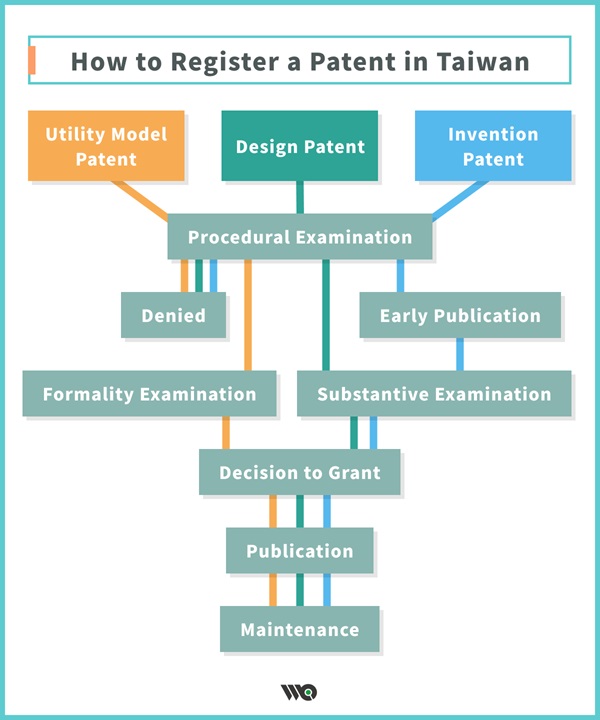
Step 1. Procedural Examination
The first step in the patent examination process is to ensure that all required documents are submitted in full and completed accurately.
The application, submitted in Traditional Chinese, must include essential details. When applying for patents, apart from providing the application’s name, nationality, and address, other specific requirements must be met:
- Invention Patent: Description, claims, abstract, and necessary drawings.
- Utility Model Patent: Description, claims, abstract, and drawings.
- Design Patent: Description and drawings.
Additionally, documents like the Power of Attorney, Grace Period Certificate, and International Priority Document must be provided within specific timeframes, with translations into Traditional Chinese if necessary. It's important to note that the applicant can initially file the specification in select foreign languages, such as English, Japanese, Korean, Spanish, French, German, Russian, Portuguese, and Arabic, then submit the translated version at a later time.
Here are some more details about the documents mentioned above.
Power of Attorney
First, if an applicant hires a patent attorney, they must submit a document (Power of Attorney) to TIPO that outlines the attorney’s authority and provides an address for receiving official notices.
Grace Period
Moreover, a grace period allows certain disclosures of an invention, utility model, or design to be excluded when assessing its novelty and inventiveness. For inventions and utility models, the grace period is 12 months; for designs, it’s 6 months, starting from the earliest disclosure in Taiwan.
If an applicant unintentionally or intentionally discloses their creation (e.g., through publication or public use) and files a patent within this timeframe, the disclosure won’t affect the patent’s validity. To claim the grace period, applicants must provide proof of disclosure dates and relevant details.
Priority Claim
Although Taiwan is not part of many international systems like the World Intellectual Property Organization (WIPO) or the Patent Cooperation Treaty (PCT), it still allows foreign applicants to claim priority from PCT applications when filing in Taiwan. To do this, the Taiwanese application must be filed within 12 months of the earliest filing date of the foreign application, rather than the 30-month timeframe used for national phase entry in PCT countries.
After Taiwan joined the WTO, applicants from WTO member countries can claim priority for Taiwanese patents within 12 months (6 months for design patents). Applicants from non-WTO member countries can also claim priority if they have a business or residence in a WTO member country.
Common errors to avoid at this point include ensuring that inventors are natural persons and ensuring consistency in signatures across application documents. For the Grace Period Certificate and the Priority Document, you must submit the original copies.
The Taiwan IP Office will assign a filing date and application number upon submission, operating under a first-to-file system, emphasizing the importance of promptly securing a filing date to establish precedence.
Step 1.1 Laid-open Publication ( or Early Publication)
For invention patents, the application is automatically published in the Patent Gazette 18 months from either the filing date or the earliest priority date. This publication allows any party to request inspection, transcription, photography, or copying of the application's specifications or drawings.
Step 2-1. Substantive Examination
For invention patents, substantive examination is essential to determine patentability. The applicant must request this examination within three years from the filing date or at the time of filing the initial application.
The invention must meet several criteria, including usability, novelty, and non-obviousness. Usability ensures practical industrial applicability, while novelty mandates that the invention is not identical to the prior creations. Non-obviousness denotes that the invention represents an advancement beyond existing technology.
During examination, the examiner conducts searches for prior art and similar documents. If the application is deemed unpatentable, an Office Action is issued, allowing the applicant to address objections through arguments or amendments with detailed claims, drawings, and other documents.
For design patents, substantive examination is compulsory and automatically initiated by the IP Office if the application satisfies the previous procedural requirements.
Similar to invention patents, the design must fulfill patentability prerequisites, including usability, novelty, and non-obviousness. Usability ensures practical application feasibility, while novelty requires differentiation from the prior art. Non-obviousness signifies advancement beyond existing designs. During examination, the examiner assesses novelty and creativity, searching for similar or identical prior designs. If the application is found unpatentable, an Office Action is also issued, providing the applicant an opportunity to address objections through arguments or amendments, just like the case with invention patents.
Applicants can make amendments during the examination process, but if TIPO issues an office action, the changes must be made within the specified time frame and must stay within the scope of the original filing. Once TIPO issues a final notice, only limited amendments are allowed. These include deleting claims, narrowing their scope, correcting errors, or clarifying unclear statements.
Applicants can make amendments during the examination process, but if TIPO issues an office action, the changes must be made within the specified time frame and must stay within the scope of the original filing. Once TIPO issues a final notice, only limited amendments are allowed. These include deleting claims, narrowing their scope, correcting errors, or clarifying unclear statements.
Applicants can make amendments during the examination process, but if TIPO issues an office action, the changes must be made within the specified time frame and must stay within the scope of the original filing. Once TIPO issues a final notice, only limited amendments are allowed. These include deleting claims, narrowing their scope, correcting errors, or clarifying unclear statements.
Step 2-2. Formality Examination
The formal examination system applies only to utility model patents, derived from substantive examination but focusing solely on confirming compliance with formal requirements.
It evaluates whether the invention meets the criteria of a utility model, focusing on its shape, structure, or combination. In addition, it examines the documentation, including the specification, claims, abstract, and drawings, to ensure compliance with formatting standards. Finally, it checks for any breaches of public order or morality and assesses the application content's clarity and completeness, looking for any notable discrepancies between the specification, independent claims, and drawings.
Step 3. Grant
Following approval, the IP Office grants and publishes the patent in the Patent Gazette, while also sending the patent certificate to the applicant. The applicant must settle the certification fee and the first-year annuity, which is consistent across all three patent types.
The official grant fee for Taiwan patents must be paid within three months of receiving the Notice of Allowance, with no possibility of extension. The fee for a design patent is NT$1,800 (discounts available for eligible applicants), but the fees for invention and utility model are all NT$3,500.
Step 4. Maintenance
The term of each type of patent varies, and annual fees are due each year starting from the first one. These fees should be paid within three months of receiving the Notice of Allowance, with subsequent annuities due one day before the anniversary of the publication date. While late payments are allowed within a six-month grace period, they incur a surcharge, which can be as high as the original fee.
If the annual fees for the second or later years are not paid on time, the patentee can still pay within the grace period with the surcharge. If both the fee and surcharge are not paid by the end of the grace period, the patent will expire. However, if the failure to pay is unintentional, the patentee can apply for reinstatement within one year of the grace period's expiration by paying three times the original fee.
Additionally, upon publication of a utility model patent application, any person may request a “Technical Evaluation Report of the Utility Model Patent”. Since utility model patents are not subject to substantive examination to verify patentability, this report serves as an essential basis for assessing the patent’s validity.
In practice, the patent owner must obtain the report before asserting infringement, as it provides evidence of the patent’s novelty and inventive step. Conversely, a party accused of infringement may also request the report to challenge the patent’s validity, potentially demonstrating that the patent does not meet the requirements for patentability.
Patent Application Conversion
In Taiwan, applicants can request a conversion of their patent application before the original patent grant decision is made. The filing date of the original application will be used as the filing date for the converted application. If an invention or design patent application is rejected, applicants can request conversion within 2 months of the rejection decision. For utility models, the request must be made within 30 days.
There are several types of conversions allowed, including:
- An invention into a utility model or design.
- A utility model into an invention or design.
- A design into a utility model or derivative design.
- A derivative design into a standard design.
A derivative design refers to a design that is based on a previously filed standard (original) design, sharing similar features but differing in minor aspects such as shape, pattern, or color. vHowever, the converted application cannot go beyond the scope of the original application’s description, claims, or drawings.
Post-Grant Amendment
In Taiwan, patentees can request a post-grant amendment to modify the description, claims, or drawings of their granted patent. This request can be made throughout the patent term, with a fee of NT$2,000 per request.
For invention and design patents, amendments can be made to delete or narrow down claims, correct errors, or clarify ambiguous statements. However, amendments cannot extend beyond the scope of the original filed content, except for translation corrections.
Utility model patents can only be corrected (post-grant amendments) during specific periods, such as when a technical evaluation report is being prepared or during litigation. These corrections are subject to the same limitations as invention patents, as they must not substantially alter or broaden the original claims, description, or drawings.
Payment and Fees
Fees can be paid via cash, bank transfer, telegraphic transfer, check, or through a deposit account with TIPO. However, TIPO does not accept direct payments from individuals residing outside Taiwan; payments must be made by a local agent. If you withdraw your patent application before the first office action is issued, the substantive examination request fee you paid can be refunded.
| Fee Type | Invention Patent | Utility Model Patent | Design Patent |
|---|---|---|---|
| Application Fee | NT$3,500 | NT$3,000 | NT$3,000 |
| Substantive Examination Fee | NT$7,000 | Not Applicable | Not Applicable |
| Annual Fee (1st to 3rd Year) | NT$2,500 per year | NT$2,500 per year | NT$800 per year |
| Annual Fee (4th to 6th Year) | NT$5,000 per year | NT$4,000 per year | NT$2,000 per year |
| Annual Fee (7th to 9th Year) | NT$8,000 per year | NT$8,000 per year | NT$3,000 per year |
| Annual Fee (10th Year & Beyond) | NT$16,000 per year | Not Applicable | NT$3,000 per year (till 15th year) |
| Certification Fee | NT$1,000 | NT$1,000 | NT$1,000 |
| REplacement of Certificate | NT$600 | NT$600 | NT$600 |
Additional fees may apply for claims exceeding 10 and for application documents exceeding 50 pages as we mentioned before. Natural persons, schools, and small and medium-sized enterprises (SMEs) may qualify for reduced annual fees for patent applications.
For invention and utility model patents, there is a reduction of NT$800 per year for the 1st to 3rd years, and NT$1,200 per year for the 4th to 6th years. The same fee reductions apply to design patents, with NT$800 off per year for the 1st to 3rd years and NT$1,200 off per year for the 4th to 6th years.
Please refer to the official site or contact us for comprehensive and up-to-date information regarding the fees or the procedures.
Patent Infringement and Remedies
In Taiwan, infringement is generally assessed through literal infringement and the doctrine of equivalents. Literal infringement occurs when the accused product or process contains every technical feature stated in the patent claim. If the accused product does not meet every claim element exactly, the court may still find infringement under the doctrine of equivalents when it performs substantially the same function, in substantially the same way, to achieve substantially the same result.
Direct and Indirect Infringement
Direct infringement occurs when a person makes, sells, offers for sale, uses, or imports a patented product without authorization. For process patents, infringement may include using the patented process or selling, using, offering for sale, or importing products directly made by that process.
Taiwan’s Patent Act does not expressly define indirect infringement. However, parties who assist, induce, or knowingly contribute to infringement may still face liability under the joint tort principles of the Civil Code, especially when a corresponding direct infringement exists.
Remedies Available to Patent Owners
Patent owners and exclusive licensees may seek civil remedies, including injunctions and monetary damages. A court may order the infringer to stop ongoing infringement, prevent likely future infringement, or destroy infringing goods, materials, or equipment used to produce them. Preliminary injunctions may also be requested when urgent protection is needed before a final judgment.
For monetary compensation, Taiwan generally recognizes three main damage calculation methods: the patent owner’s actual loss, the profits gained by the infringer, or reasonable royalties that would have been paid for lawful use of the patent. If the infringement is intentional, the court may increase damages up to three times the proven loss or infringer’s gains.
Recent Proposed Changes to the Taiwan Patent Act
The TIPO first announced draft amendments to the Patent Act on September 11, 2024, followed by a second draft in March 2025. These revisions are still under review and have not yet come into effect. Their main objectives are to modernize Taiwan’s design patent system in response to rapid developments in digital technology and to strengthen the legal framework for resolving patent ownership disputes.
Expansion of Design Patent Protection
To adapt to the rise of digital and virtual technologies, the draft amendments propose extending design patent protection beyond traditional physical products.
Under the current Patent Act, computer-generated icons and graphical user interfaces must generally be applied to an article to qualify for design patent protection. Under the second draft, computer-generated icons and graphical user interfaces would be treated as “articles,” allowing them to be protected as standalone design patent subject matter. This change would cover graphics used in emerging fields such as virtual reality, augmented reality, software interfaces, and metaverse environments.
The second draft also clarifies how the practice of a design patent should be understood. Instead of separately listing online or digital use activities, the practice of design patents would follow the rules for “article inventions” under Article 58 of the Patent Act.
Multiple Similar Design Joint Application System
Recognizing that designers often create multiple variations of a concept, TIPO proposes a new mechanism allowing applicants to file two or more similar designs in a single application, and complementing the existing derivative design structure.
Under this proposal, one design must be designated as the original design, while others are filed jointly under the same application. Related legislative adjustments include allowing patentees to delete a design post-grant and introducing Article 141-1, which specifies that each design within a joint application can be individually challenged through invalidation proceedings.
Extension of the Grace Period for Design Patents
To align with international practice and give applicants more flexibility, the draft amendments propose extending the grace period for design patents from six months to twelve months.
This means that if a design is disclosed before filing, the applicant may still be able to file a design patent application within twelve months without losing novelty, subject to the applicable legal requirements. This change would better support designers and businesses that need to display, test, or promote a design before completing the filing process.
“True Applicant” Rights Recovery
The draft amendments also address ownership disputes involving the true applicant or rightful patent owner. While the first draft proposed stronger reliance on civil proceedings, the second draft revised this approach.
Under the latest proposal, TIPO would maintain the invalidation system for patent ownership disputes. At the same time, the draft adds supporting measures to prevent the nominal patent owner from abandoning the patent right before the dispute is resolved. This approach aims to protect the interests of the true applicant while keeping the dispute resolution process more practical.
Classification and Procedural Updates
Finally, procedural flexibility is being improved through changes to the filing period for divisional design applications. The proposed amendment to Article 130 would allow applicants to submit a divisional application within three months after receiving the approval decision from the initial examination or the allowance decision from reexamination.
This extended timeframe gives applicants greater control over portfolio management and strategic filing, especially when multiple design features or similar design variations are involved.
FAQs
What are the types of patents in Taiwan?
The types of patents in Taiwan include invention patents, utility model patents, and design patents. Design patents aim to improve visual appeal and draw consumer attention, whereas utility models and invention patents concentrate on improving functionality and usability with the latter covering a broader scope of innovation.
Do I need a representative to file my patent application as a foreign applicant?
Yes, foreign applicants must appoint a qualified patent attorney in Taiwan to file a patent application on their behalf.
What documents are needed for filing a patent application in Taiwan?
Required documents for filing a patent application in Taiwan include the application form, specification, description, claims, drawings, an abstract (if applicable), and a power of attorney.
Can I file a patent application other than Traditional Chinese?
The application form must be in Traditional Chinese. However, applicants may initially file the specification, claims, and drawings in a foreign language (e.g., English, Spanish, or Japanese) to secure a filing date. A Chinese translation must then be submitted within the prescribed time limit, or the application will be deemed withdrawn.
How much is it to file a patent application in Taiwan?
The cost to file a patent application in Taiwan varies depending on the type of patent and the complexity of the application. While the fee for an invention patent may be higher, the fees for the design patent and utility model patent are fixed at NT$3000 each.
How long is patent protection in Taiwan?
In Taiwan, patent protection depends on the patent type. Invention patents last 20 years, utility model patents last 10 years, and design patents last 15 years from the filing date. Rights begin from the publication date of grant, and annual maintenance fees must be paid to keep the patent valid.
What is the grace period for filing a patent in Taiwan?
Taiwan currently provides a grace period for certain prior disclosures made before filing. For invention and utility model patents, the period is 12 months from the earliest disclosure. For design patents, the current period is 6 months, though recent draft amendments propose extending design patent grace period to 12 months.
Is there a patent office in Taiwan?
Yes. Taiwan’s patent authority is the Taiwan Intellectual Property Office, or TIPO, under the Ministry of Economic Affairs. TIPO handles patent applications, examinations, grants, publications, fee matters, and patent information services.
WPTO - the Best Taiwan Law Firm to Help You File Patents
Let WPTO, a trusted Taiwan IP firm, guide you through the process of filing your patent in Taiwan. With over 70 years of expertise in providing comprehensive IP services, our team of experienced attorneys, patent agents, patent engineers, and consultants ensures your patent rights are safeguarded effectively.
From electronics to biotech, and beyond, our specialists excel in securing Taiwan patents, trademarks, and intellectual property across various fields. With extensive experience in Taiwan patents, Taiwan trademarks, China trademarks, Japan trademarks, and international trademarks, we leverage our technical expertise and industry knowledge to protect your IP. Trust our team to guide you through the patent and trademark application process. Contact us today to get started!
Read More:
China Trademark Registration: Full Guide for Foreign Companies
Japan Trademark Registration Guide: Process, Costs & How to File
Full Guide on EU Trademark Registration: Filing, Fees, & More
How to Register a South Korean Trademark: A Complete Guide
Read More:
China Trademark Registration: Full Guide for Foreign Companies
Japan Trademark Registration Guide: Process, Costs & How to File
Full Guide on EU Trademark Registration: Filing, Fees, & More
How to Register a South Korean Trademark: A Complete Guide
Invention

Utility Model

Design
